

Technological innovations, especially in the field of artificial intelligence (AI) continue playing an essential role in the shaping of the future of humanity across different industries. As technology continues to evolve, it also reshapes human lives, how they work and their interaction. Consequently, the future demands adaptability and resilience for a successful and thriving society.
Major Concerns
The growing technological innovations are becoming a major concern for the majority of people in our society. In a study carried out in Great Britain between 27 March to 1 April 2025 to determine the biggest concern employees had about the use of AI, 26% of the respondents were worried about job losses, 17% were worried about the possibility of AI making errors, while 15% were worried about a lack of AI regulation. Similarly, there were concerns about data protection with 11% of the respondents reporting their worries about data security.
A global survey conducted by the Melbourne Business School in collaboration with KPMG between November 2024 and January 2025 found that 79% of the respondents were concerned about the risks associated with AI. Specifically, respondents identified “the loss of human interaction and connection, cybersecurity risks, loss of privacy or intellectual property, misinformation and disinformation, manipulation or harmful use, inaccurate outcomes, deskilling and dependency, job loss, and disadvantage due to unequal access to AI” as major negative outcomes that arose from the adoption of AI. The fact that respondents across all 47 countries that were sampled for the survey shared similar views is a confirmation that concerns about AI are a global issue.Rise in AI Adoption
Despite the prevailing concerns, there has been a rapid rise in the adoption of AI not only for personal use but also in business and research. An AI Diffusion Report that was released by Microsoft’s AI Economy Institute revealed that since its introduction, the rate of AI adoption has been faster compared to the internet, personal computers, and smartphones. Singling AI as the fastest spreading technology, the report pointed out that at least 1.2 billion people have used AI tools.
A McKinsey & Company survey report on the state of AI in 2025, showed that 88% of respondents confirmed the use of AI in at least one business function. Researchers have not been left behind. A Wiley study conducted between July 31 and August 18, 2025 found that the number of researchers using AI increased from 57% in 2024 to 84%. Researchers noted that AI had played a vital role in improving their efficiency and enhancing the quantity and quality of their work.Future Impacts
Business Automation
Currently, many businesses have reported increased task automations resulting from the use of generative AI. This trend is likely to continue going into the future. As chatbots and digital assistants keep rising, the number of companies relying on AI to ensure that simple conversations with clients are handled will continue to rise. Additionally, the fact that AI can conduct fast data analysis and provide instant feedback on its findings makes it invaluable for companies that strive in quick decision-making processes. The instant insights that are produced by AI make it easier for organization leaders to engage in informed decision-making instead of spending a lot of time parsing through the massive amounts of data.
Innovation
AI continues and will continue playing a vital role in accelerating innovation across different industries. For instance, AI-enabled robotics have benefitted manufacturing industries. Usually, the robots work alongside humans as they perform limited tasks including assembling and stacking of items, while predictive analysis sensors are used to keep equipment running smoothly.
In finance, AI plays an essential role in the detection of fraud, evaluation of customer loans and conducting audits. The education sector also remains at the center of AI and its associated impacts. For instance, AI can be used to carry out textbook digitization, plagiarism detection and gauging the emotions of learners to determine those who are struggling.
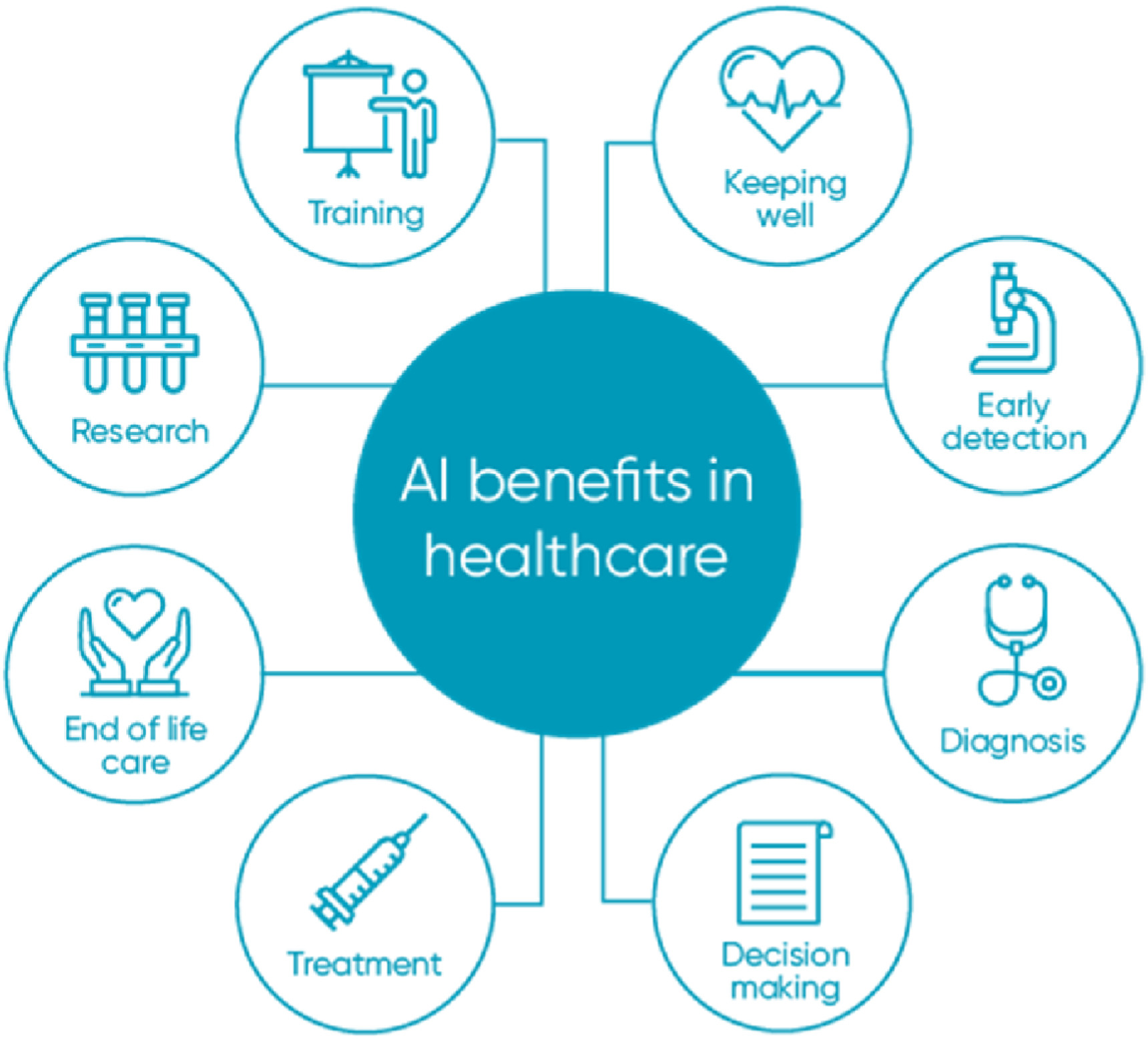
In healthcare, AI has changed the way people interact with healthcare providers. Through telemedicine, AI improves diagnostics, real-time monitoring and engagement with patients who live in remote areas. The fact that people do not have to travel long distances to meet healthcare providers is laudable because it boosts efficiency and accessibility of healthcare services for all individuals irrespective of their geographical location. Integrating AI into healthcare bridges the gap in the medical workforce crisis. The following diagram shows more AI benefits:
Climate Change
AI is also likely to have significant impacts on climate change in future. For most environmentalists, the fact that AI requires a lot of energy to process all the data needed to ensure that AI continues to run is a major concern. For instance, the International Energy Agency reported that a request made to ChatGPT, an AI-based tool, results in the consumption of 10 times the electricity of a Google Search. However, speaking during an interview at WSJ’s Journal House at the United Nations Climate Change Confederation, COP 28, Google’s Chief Sustainability Officer (CSO) Kate Brandt maintained that AI can also be used as a tool for combating climate change due to its ability to provide more information on how to reduce carbon footprints and how to have a better understanding of sustainability data.Despite the observation by Google’s CSO, even if there is an application of AI to climate-conscious technologies, the costs required to build and train models are likely to worsen the already volatile environmental situation. A study conducted at the University of Massachusetts, Amherst, found that training a single AI model results in carbon dioxide emissions that are five times the emissions an average car produces in its lifetime. Additionally, estimations indicate that emissions from the Information and Communications Technology (ICT) industry are likely to reach 14% of the global emissions by 2040. Majority of the emissions will be generated by the ICT infrastructure, especially data centers and communication networks. AI technology also produces e-wastes that contain hazardous chemicals such as lead, mercury and cadmium, whose soil and water contamination poses significant risk to human health and the environment.
The Need to Adapt
As society moves forward, individuals and institutions must embrace agility, continuous learning and rethink traditional approaches. The ability to adapt will determine not only success but survival in a rapidly changing world. Adaptability will be essential because it will make it easier to turn challenging issues into advantages, and enable individuals to thrive in a shifting landscape. Although some jobs are likely to disappear as a result of AI, more are likely to be created. Therefore, it is important to be alert and stay informed about latest innovations in technology and use the information to get hands-on experience on AI tools.
By adjusting one’s skills and strategies in line with AI technology, it becomes easy to remain relevant in the job market where new roles are being sought. For instance, global tech hubs that drive innovation in areas such as robotics and AI have become major avenues for individuals with tech skills. Consequently, individuals with tech skills have open opportunities to work in diverse environments where their contributions can have an impact on global tech ecosystems.
Governments across different countries also need to adopt policies that are tailored towards promoting the development of tech skills. For instance, the establishment of policies that support STEM education and research can play a significant role in building an ecosystem where tech thrives. Understanding the concerns that people have about technology provides an opportunity for governments to establish appropriate regulations that address data privacy, cybersecurity and the ethics surrounding the development and use of AI.